
Supply programme · Heat treatment
Heat treatment of steel – hardening, quenching and tempering, and annealing
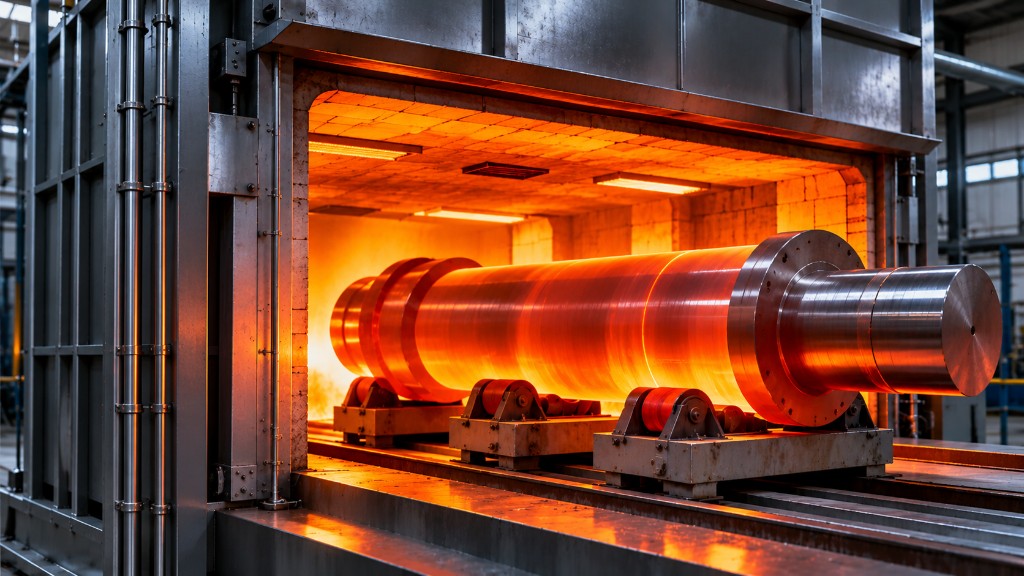
INDUSTRISTÅL offers heat treatment of steel materials as part of our overall supply programme. Many of our customers need materials with specific mechanical properties, hardness, strength or dimensional stability. We therefore offer various forms of heat treatment, adapted to the individual steel grade and application. We can supply both raw materials and machined parts with the required heat treatment, so the customer gets one complete solution with fewer links in the supply chain. The specific treatment is determined from material grade, dimensions, required properties and technical requirements.
At a glance
- One delivery – material + treatment: Raw materials, sawn parts and machined components supplied in the required condition.
- Strength and structure – +QT, +N, +A and hardening: Quenching and tempering, normalising, soft annealing, stress relieving and surface hardening.
- Quality and traceability – EN 10204 3.1 and protocol: Material certificate, treatment documentation and hardness testing by agreement.
- Technical dialogue – from drawing and requirements: We align steel grade, cross-section and heat treatment before the order is locked.
Heat treatment methods
Below is a technical overview of the heat treatment processes used for structural steel, quenched and tempered steel, case-hardening steel and tool steel. Each method has its own metallurgical purpose. Where a process is marked as possible treatment subject to further assessment, the supply option is clarified specifically from the geometry of the part, steel grade, batch size and specification in connection with the quotation.
Quenching and tempering – Vergüten
Part of supply programme (+QT). Quenching and tempering consists of hardening followed by tempering at a higher temperature to achieve a controlled combination of high tensile and yield strength and good impact toughness (+QT to EN 10083 / EN ISO 683). The treatment is adapted to the cross-section of the part and the hardenability of the steel grade.
- Process: Heating to austenitising temperature matched to the chemical analysis of the steel
- Process: Quenching in oil, polymer or water depending on alloy and cross-section
- Process: Tempering to the agreed strength range (Rm) or hardness (HBW / HRC)
- Typical applications: Shafts and rotor parts · Machine components · Gear parts and transmission shafts · Bolts and tie rods · Heavy structural parts · Highly loaded components
- Relevant grades: 34CrNiMo6 / 1.6582 · 42CrMo4 / 1.7225 · 42CrMoS4 / 1.7227 · 30CrNiMo8 / 1.6580 · C45 / 1.0503
Hardening – Härten
Offered to specification. Heat treatment intended to increase the hardness and wear resistance of the material through the formation of a martensitic structure. Carried out with material-specific process control so that the risk of quench cracks and distortion is minimised.
- Process: Austenitising at controlled temperature and soaking time
- Process: Controlled cooling (quenching) matched to alloy and part geometry
- Process: Subsequent tempering as required to reduce brittleness and stabilise the structure
- Process: Material-specific process control based on cross-section and required working hardness
- Typical applications: Wear parts and guides · Tool components, punches and dies · Machine parts requiring high surface or through hardness
- Relevant grades: C45 / 1.0503 · 42CrMo4 / 1.7225 · 1.2379 · 1.2343
Stress-relief annealing – Spannungsarmglühen
Offered to specification. Used to reduce internal stresses in the material arising from welding, casting, forging, flame cutting or heavy machining – without significantly changing the basic structure and strength of the steel.
- Process: Slow, uniform heating below the transformation temperature (typically 530–650 °C depending on steel grade)
- Process: Holding time matched to the largest section thickness
- Process: Controlled, slow furnace cooling to prevent new thermal stresses
- Typical applications: Welded steel structures · Large machine components · Machined plates and blocks · Pipe components · Parts with high demands on dimensional stability during final machining
- Relevant grades: S355J2 / 1.0577 · C45 / 1.0503 · 42CrMo4 / 1.7225 · 34CrNiMo6 / 1.6582
Normalising – Normalglühen
Part of supply programme (+N). Heat treatment intended to achieve a uniform, fine-grained structure (+N). Normalising evens out structural differences after rolling or forging and gives predictable mechanical properties and improved toughness.
- Process: Heating to a temperature just above the upper transformation point (Ac3)
- Process: Equalisation through the whole cross-section followed by cooling in still air
- Process: Produces a fine-grained ferritic-pearlitic structure ready for further machining or welding
- Typical applications: Structural and engineering steel in bar and plate · Forged parts before machining or subsequent quenching and tempering · Components requiring uniform grain size and impact toughness
- Relevant grades: S355J2 / 1.0577 · C45 / 1.0503 · 16MnCr5 / 1.7131
Soft annealing – Weichglühen
Part of supply programme (+A). Used to reduce hardness and improve machinability (+A) before further machining or cold forming. In soft annealing, lamellar carbides are transformed into spheroidised cementite.
- Process: Heating close to or cycling around the lower transformation point (Ac1)
- Process: Controlled slow cooling for the lowest possible starting hardness
- Process: Reduces tool wear in turning, milling and deep-hole drilling of high-carbon and alloy steels
- Typical applications: Tool steel and alloy quenched and tempered steel before rough machining · Parts with extensive machining before final hardening · Steel for cold forming
- Relevant grades: 1.2379 · 1.2343 · 42CrMo4 / 1.7225 · 34CrNiMo6 / 1.6582 · 30CrNiMo8 / 1.6580
Recrystallisation annealing – Rekristallisationsglühen
Possible treatment subject to further assessment. Used to reduce the effects of cold deformation (work hardening) and restore the original formability and ductility of the material without phase transformation.
- Process: Heating above the recrystallisation temperature but below Ac1
- Process: Formation of new, stress-free grains in the cold-worked structure
- Process: Feasibility is assessed case by case from the prior degree of deformation and the dimension
- Typical applications: Cold-drawn or cold-rolled parts and sections · Intermediate annealing in multi-stage cold forming
- Relevant grades: S355J2 / 1.0577 · C45 / 1.0503
Vacuum hardening – Vakuumhärten
Possible treatment subject to further assessment. Heat treatment under controlled vacuum conditions followed by high-pressure gas quenching, in which surface reactions, decarburisation and oxidation are limited. Gives high dimensional accuracy and a clean surface on finish-machined parts.
- Process: Heating in a vacuum furnace with precise temperature control and preheating stages
- Process: Uniform cooling in inert gas (typically nitrogen) followed by tempering
- Process: Offered on request after specific assessment of part geometry and batch size
- Typical applications: Tool steel for cutting, punching and forming tools · Precision components with tight requirements for dimensional stability · High-alloy special steels and industrial knives
- Relevant grades: 1.2379 · 1.2343
Induction hardening – Induktionshärten
Possible treatment subject to further assessment. Local electromagnetic heating and quenching of selected surface areas, so the part gains a hard, wear-resistant case while the core retains its toughness and strength (e.g. from a prior +QT treatment).
- Process: Rapid inductive heating of the specified surface section
- Process: Immediate spray quenching followed by low-temperature tempering
- Process: Requires a drawing stating the hardening zone, case depth (SHD/Rht) and required HRC
- Typical applications: Shafts and shaft journals · Bearing surfaces and seal tracks · Gears and toothed parts · Wear surfaces and guide tracks · Machine components with local contact loading
- Relevant grades: 42CrMo4 / 1.7225 · 34CrNiMo6 / 1.6582 · C45 / 1.0503
Case hardening – Einsatzhärten
Possible treatment subject to further assessment. Thermochemical treatment with carbon enrichment (carburising) of the surface layer followed by hardening and tempering. Used on suitable case-hardening steels with low initial carbon, where high surface hardness and a tough core are required.
- Process: Carburising in a controlled atmosphere to the specified case depth (CHD/Eht)
- Process: Hardening and stress-relieving tempering to the required surface hardness (typically 58–62 HRC)
- Process: Offered on finished or pre-machined parts after specific technical assessment
- Typical applications: Gears, pinions and ring gears · Transmission shafts and clutch parts · Wear-loaded machine parts requiring high impact toughness in the core
- Relevant grades: 16MnCr5 / 1.7131 · 18CrNiMo7-6 / 1.6587
Nitriding – Nitrieren
Possible treatment subject to specific technical assessment. Thermochemical surface treatment at relatively low process temperature (typically approx. 500–550 °C), in which nitrogen diffuses into the surface of the material and forms hard nitrides. Can improve surface hardness, wear resistance and in some cases fatigue properties with minimal distortion.
- Process: Typically carried out on finish-machined parts in the pre-quenched and tempered (+QT) condition
- Process: Requires that the tempering temperature of the +QT treatment is above the nitriding temperature
- Process: Requires suitable materials (nitriding steel or CrMo/CrNiMo quenched and tempered steel) and a specific technical assessment of the drawing requirements
- Typical applications: Spindles, shafts and guide rods · Gear parts and extruder screws · Precision components requiring high wear resistance and low runout
- Relevant grades: 42CrMo4 / 1.7225 · 34CrNiMo6 / 1.6582 · 31CrMoV9 / 1.8519
Relevant steel grades
The choice of heat treatment is closely linked to the carbon content and alloying elements of the steel. The table shows technically relevant treatment options for selected grades in our materials programme. The overview is indicative and should not be taken as a guarantee that every combination can be supplied in every dimension without prior technical assessment.
- 34CrNiMo6 · 1.6582: Quenching and tempering, annealing, induction hardening
- 42CrMo4 · 1.7225: Quenching and tempering, annealing, induction hardening, nitriding
- 42CrMoS4 · 1.7227: Quenching and tempering, annealing
- 30CrNiMo8 · 1.6580: Quenching and tempering, annealing
- C45 · 1.0503: Hardening, induction hardening, normalising
- 16MnCr5 · 1.7131: Case hardening
- S355J2 · 1.0577: Normalising, stress-relief annealing
- 1.2379: Vacuum hardening, tempering
- 1.2343: Vacuum hardening, tempering
Heat treatment of both smaller and larger steel parts
The need for heat treatment ranges from individual machine components and cut bar blanks to heavy forged parts and welded structures. We put the delivery together so that material selection, any sawing or rough machining and heat treatment fit together technically.
- Round bar and shafts: Supply of round bar in quenched and tempered (+QT), normalised (+N) or soft annealed (+A) condition – as full lengths or sawn to fixed size.
- Steel blocks and plate: Normalising, stress-relief annealing and soft annealing of flat bar, plate and cut blocks in structural and tool steel.
- Forged parts: Open-die forged shafts, rings, discs and blocks supplied with documented heat treatment (+QT or +N) and the associated mechanical tests.
- Welded structures: Stress-relief annealing after welding to reduce residual stresses and ensure dimensional stability during subsequent machining.
- Tubes and special components: Heat treatment of thick-walled tubes, fittings, flanges and bored parts adapted to the requirements of the process, energy and machine industries.
- Finish-machined machine parts: Option of surface and vacuum hardening after further technical assessment of drawing, tolerance requirements and material selection.
Interaction between machining and heat treatment
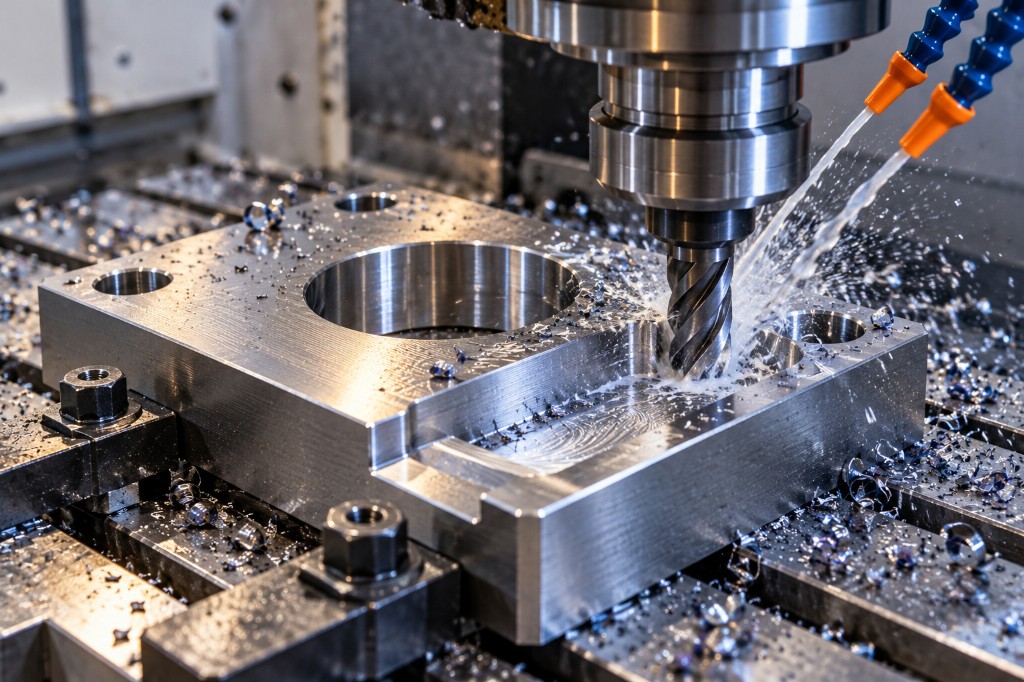
From raw steel to milled and treated component. For complex, milled machine components we plan the sequence of sawing, rough machining, stress-relief annealing or hardening and any finish machining, so the part keeps its form and dimensional tolerances. The options depend on the dimensions, weight and steel grade of the part and the required heat treatment process. Contact us with your specifications, and we will look into the relevant solution.
Documentation and quality requirements
When heat treatment is part of a delivery, it is important to distinguish clearly between the steel mill's original material certificate, the documentation of the heat treatment process itself and the results of subsequent mechanical testing. The scope of documentation is always agreed and confirmed in connection with the quotation.
- 1. Material certificate – EN 10204 3.1: Documents the heat analysis (chemistry), heat number and the properties the material was supplied with from the mill. Third-party certificate (3.2) can be agreed on relevant deliveries.
- 2. Treatment documentation – heat treatment protocol: For separate heat treatment of parts, treatment documentation or a furnace protocol documenting the process carried out can be supplied by agreement.
- 3. Test results – hardness and mechanical testing: Verification of the mechanical properties achieved after treatment – including hardness testing (HBW/HRC/HV), tensile testing (Rp0.2 / Rm / A5) and impact testing (Charpy-V), plus re-stamping and traceability.
Checklist for your enquiry
Please state the following for the quotation:
- Steel grade: EN designation or Werkstoffnummer (e.g. 42CrMo4 / 1.7225 or 34CrNiMo6 / 1.6582).
- Dimensions and quantity: Cross-section (Ø, thickness, width), part length and number of pieces.
- Required heat treatment: E.g. quenching and tempering (+QT), stress-relief annealing, normalising (+N) or surface hardening.
- Mechanical requirements: Required hardness range (HBW/HRC), strength class (Rm) or case depth.
- Drawing and documentation: Please attach the technical drawing and state requirements for EN 10204 3.1, protocol or testing.
- Required delivery date: When the parts are to enter your production.
Frequently asked questions
- What is the difference between hardening and quenching and tempering?
- In hardening, the steel is heated to austenitising temperature and cooled rapidly, which gives high hardness and wear resistance but lower toughness. In quenching and tempering (+QT), hardening is followed by tempering at a higher temperature (typically 540–680 °C), which lowers the hardness in a controlled way and gives the combination of high yield strength, tensile strength and impact toughness required in shafts and load-bearing machine parts.
- Can 34CrNiMo6 be supplied quenched and tempered?
- Yes. 34CrNiMo6 / 1.6582 is supplied as standard in the quenched and tempered condition (+QT to EN 10083-3 / EN ISO 683-2) and, thanks to its nickel, chromium and molybdenum content, is particularly suitable for heavy cross-sections with high demands on through-hardening and core properties.
- Can 42CrMo4 be induction hardened?
- Yes, 42CrMo4 / 1.7225 is well suited to induction hardening – typically starting from a quenched and tempered (+QT) base structure. That gives a wear-resistant surface on e.g. bearing seats or toothed parts, while the core retains its strength and toughness. Induction hardening is offered after specific assessment of drawing and hardening zone.
- What is the purpose of stress-relief annealing?
- Stress-relief annealing (Spannungsarmglühen) reduces internal and residual stresses after welding, forging, flame cutting or rough machining. The purpose is to prevent warping, twisting and dimensional changes during subsequent finish machining or in service.
- Can large steel parts be heat treated?
- Yes, we can supply both smaller components and large round bars, blocks, plates and forged parts with heat treatment. The options depend on the dimensions, weight and steel grade of the part and the required process, which is clarified on enquiry.
- Can INDUSTRISTÅL supply materials including heat treatment?
- Yes. We offer one complete solution in which the steel material, any sawing or machining and the agreed heat treatment are part of the same delivery, so you have one contact and fewer links in the supply chain.
- What documentation can be supplied?
- Depending on the requirements of the order, we can agree a material certificate to EN 10204 3.1, a heat treatment protocol (time/temperature record), hardness testing and results from mechanical testing (tensile test and impact test/KV) and full heat traceability. The documentation requirements must be specified and confirmed at quotation.
- Can heat treatment be carried out to a technical drawing?
- Yes. Please send the technical drawing or specification with details of steel grade, required heat treatment, target range for hardness (HBW/HRC) or tensile strength (Rm) and requirements for testing and certificate, and we will assess the job and put together a quotation.
Read more
Get a quotation for heat treatment of steel
Send steel grade, dimensions, number of parts, required heat treatment and requirements for hardness or documentation. You can also attach the technical drawing directly in the enquiry.